



LeMa
Learning to read and do Maths
What is the project about?
Reading and maths are key areas of learning in primary school. These two skills are interlinked as children develop. At the same time, there are children who struggle in only one or in both areas. The reasons behind these links have not yet been thoroughly researched. In our research project, we aim to find out how children learn to read and do maths most effectively, and which skills are important for their development.
To this end, we would like to carry out various tasks with Year 3 pupils relating to reading, writing and maths. In addition, they will complete playful tasks focusing on language processing (processing speech sounds), memory, concentration and attention, as well as general problem-solving skills and processing speed.
The results will help us identify the prerequisites for reading and maths. This is important for providing children with timely and tailored support.
How can you get involved?
We are contacting schools in Graz and the surrounding area to invite them to take part. If the headteacher and the relevant teacher (Year 3) agree, consent forms will be distributed to parents and carers.
If you are interested in taking part or have any questions about our project, please contact Rebecca Teuschl (rebecca.teuschl@uni-graz.at).
We look forward to hearing from you!

What is the project timeline?
Part 1: As a first step, schools in Graz and the surrounding area, as well as in Munich, will be invited to take part. The aim is to reach around 1,600 pupils in both Graz and Munich. This will enable us to gather data on a diverse range of pupil profiles, allowing us to compare strengths and weaknesses in the areas of reading and maths. Various tasks (e.g. relating to reading or memory) will be carried out with these pupils in a classroom setting.
Part 2: Next, a similar set of tasks will be carried out again with a selection of pupils (800 in Graz and 800 in Munich) in smaller groups. These children will be selected by us.
Part 3: To examine how consistently reading and maths skills develop over time, the children from Part Two will be invited back 18 months after the initial assessment to complete further tasks.
What is the idea behind the project?
The project is being carried out by the University of Graz (Institute of Psychology) in collaboration with Ludwig Maximilian University of Munich.
At the University of Graz, Rebecca Teuschl, BSc, MSc, as well as student research assistants, are involved in the project. The project is led by Professor Karin Landerl.
The Styrian Department of Education has been informed about our research project, and our study has been approved by the Ethics Committee of the University of Graz.
The project has been reviewed by the Austrian Science Fund (FWF) and is being funded on the basis of its high scientific relevance.
Why should you take part?
Free support programme: Participating schools receive six months’ free access to the Meister Cody digital learning programme (Namagi German and Talasia Maths). Participating children receive a licence for free support at home for a whole year.
Further information on this scientifically-backed digital learning programme can be found here: https://www.meistercody.com/products/namagi-deutsch-meistern,
https://www.meistercody.com/products/talasia
Research findings relevant to schools: The education system is also set to benefit from the findings of our research project. Through a better understanding of learning difficulties and the early identification of affected children, tailored support programmes can be developed and implemented.
Feedback to teachers: Survey results will be shared with teachers once parental consent has been obtained. Detailed feedback on the children’s developmental progress in reading and maths can support further lesson planning.

Here’s a look at the activities and games we do with the children
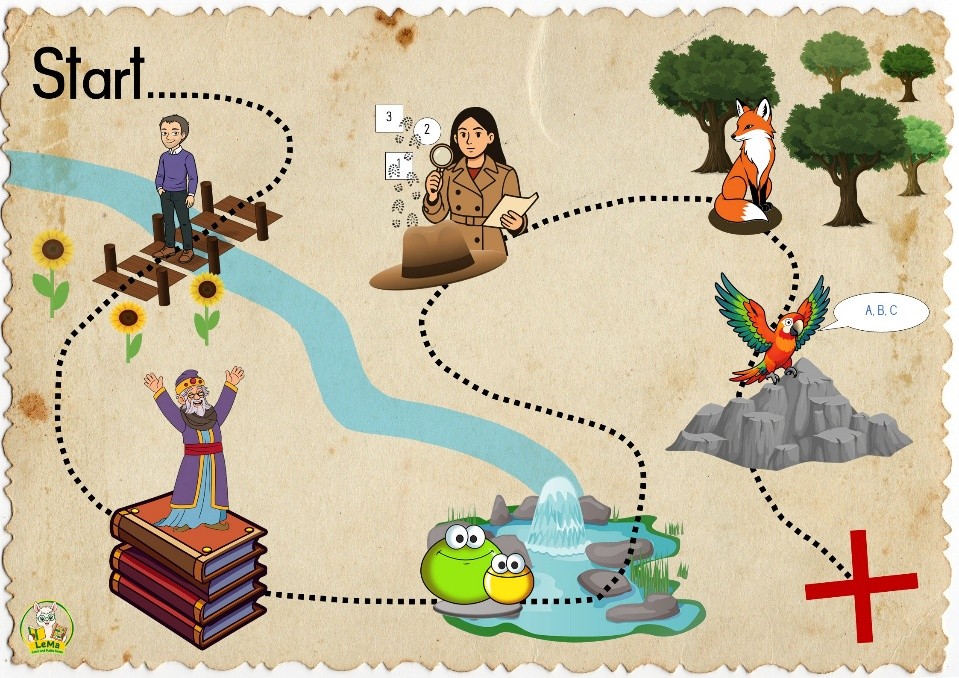
We set off on an adventure with the llama ‘Lema’. Along the way, we play lots of different games, complete tasks and solve puzzles. Many of the tasks and games are carried out on a tablet. They are designed to be child-friendly and usually have a time limit. This ensures they are seen as varied and helps to avoid overwhelming the children. All the necessary equipment (e.g. tablets, headphones) is provided by the project team.
Reading fluency: Sentences are read aloud quietly, and the children are asked to judge whether the sentence is correct or not.
Reading comprehension: Two sentences are then read out, and the children have to decide whether the two sentences go together.
Spelling: The children now take on the role of the teacher: sentences are displayed on the tablet, in which some words are spelled correctly and others incorrectly. The children must find as many misspelled words as possible.
Maths: The children decide whether given maths problems have been solved correctly or incorrectly.
Word problems: An example of this is: Willi has twice as much money in his piggy bank as Sam. Together they have 210 euros. How much money does Willi have, and how much does Sam have?
Finding
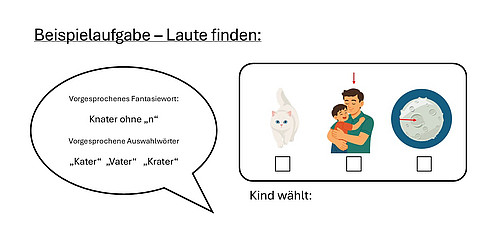
sounds: The children listen to made-up words and have to work out which word results when a sound is omitted.
Writing numbers: The children hear a number through headphones and type it into the tablet.
Logical thinking: The children solve tricky problems in which they have to complete sequences of pictures or patterns in a logical way.
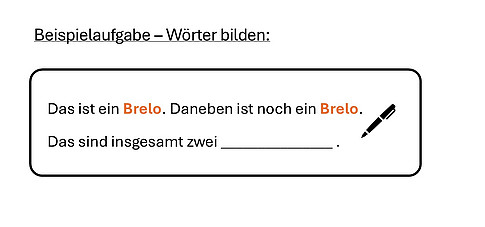
Forming words: The children have to work out how a made-up word fits correctly into a sentence.
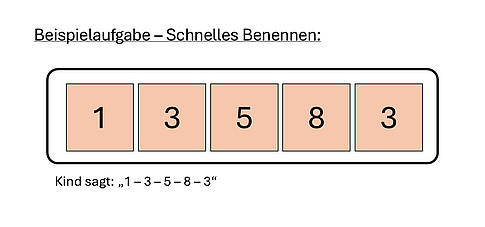
Quick naming: The children see a sequence of pictures or numbers on the tablet and have to name them out loud as quickly as possible.
Vocabulary: The children find the picture that best matches a spoken word.